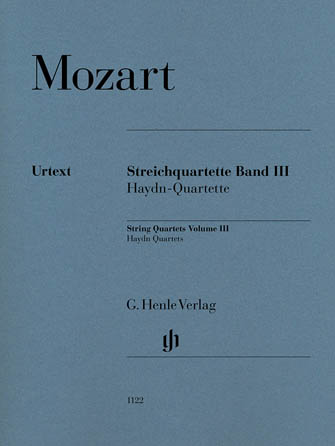
Mozart devoted special time and attention to these six string quartets, and dedicated them to none other than the 'creator' of the genre himself: Joseph Haydn. 25 years ago Wolf-Dieter Seiffert, the editor of this new Henle Urtext edition, penned the Critical Report for these Haydn Quartets in the New Mozart Edition. He is now offering this core repertoire in an edition all its own. This Urtext edition resolves numerous inaccuracies in different editions, especially dynamics, articulation, and even a couple wrong notes that had gone unnoticed up to now. Exceptional detail has been placed to making the music with ideally placed page turns and easy to read.
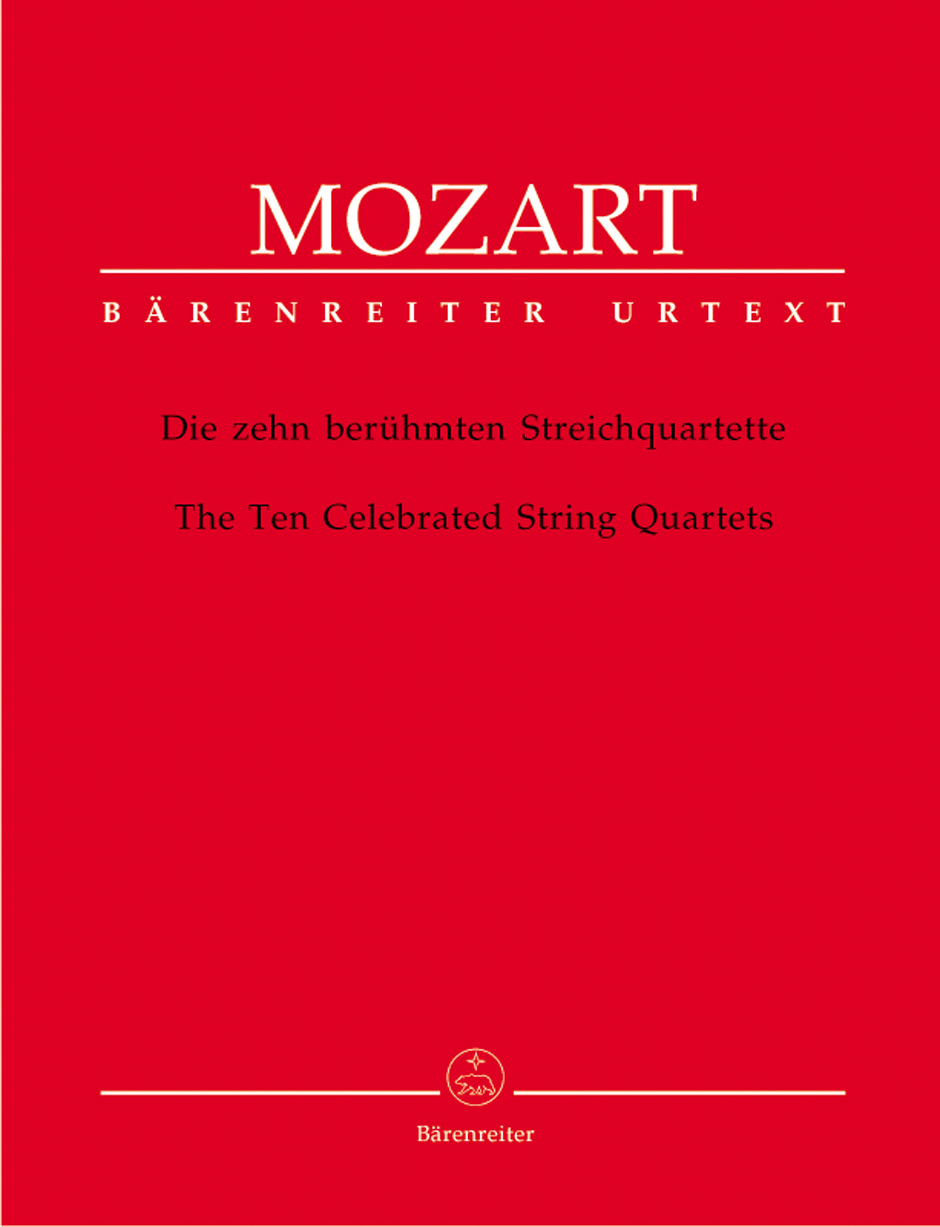
The present volume contains those ten string quartets of Mozart which have become famous as the composer’s greatest contribution to the medium and which are frequently performed in public. According to the dates of their composition and publication they may be divided into three groups: the six “Haydn” Quartets K.387, 421 (417b), 458, 428 (421b), 464 and 465; the so-called Hoffmeister Quartet K.499, and the three “Prussian” Quartets, K.575, 589 and 590.
Contents:
1. Quartet in G Major, K. 387
2. Quartet in D minor, K. 421 (417b)
3. Quartet in B-flat Major, K. 458 “Hunt”
4. Quartet in E-flat Major, K. 428 (421b)
5. Quartet in A Major, K. 464
6. Quartet in C Major, K. 465 “Dissonance”
7. Quartet in D Major, K. 499
8. Quartet in D Major, K. 575
9. Quartet in B-flat Major, K. 589
10. Quartet in F Major, K. 590
String Quartet
Comprised of works from Volumes 1, 2, and 3 of the Suzuki Violin School, which have been arranged for string quartet by violinist/arranger Joseph Knaus. With lower string parts providing melodic and rhythmic counterpoint to set off the simple melodies (which match the Suzuki Method® repertoire), these quartets are nevertheless simple enough for beginning level players ready for their first chamber music experience. String Quartets for Beginning Ensembles are sold in sets including full score and one part book per instrument.
Contents:
• Twinkle, Twinkle, Little Star Theme and Variations (Shinichi Suzuki)
• Lightly Row (Folk Song)
• Song of the Wind (Folk Song)
• Go Tell Aunt Rhody (Folk Song)
• O Come, Little Children (Folk Song)
• May Song (Folk Song)
• Long, Long Ago (T. H. Bayly)
• Allegro (Shinichi Suzuki)
• Etude (Shinichi Suzuki)
• Perpetual Motion (Shinichi Suzuki)
• Allegretto (Shinichi Suzuki)
• Andantino (Shinichi Suzuki)
• Gavotte (F. J. Gossec)
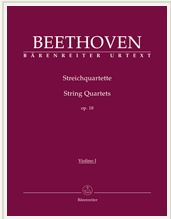
The internationally renowned Beethoven scholar has turned his attention to a set of chamber musical crown jewels; Beethoven’s important opus 18 string quartets. The new Bärenreiter publication is not based on a reprint of the first edition parts, but makes use of a manuscript set of parts with some corrections in Beethoven’s hand which turned up in the 1980s.
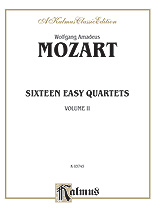
This collection consists of the sixteen listed string quartets, with separate scores for each instrument.
Contents: K. 155, 156, 157, 158, 159, 160, 169, 170, 171, 172, 173, 285, 298, 370, 546
Any combination and any number of instruments can play together in harmony. Woodwinds, brass, strings, and mallet percussion can have fun playing in like-instrument or mixed-instrument ensembles. Quartets for All covers a wide range of styles and music by composers from baroque through contemporary eras. Difficulty ranges from grades I through III. The pages are laid out in an identical manner in each book so that performers can quickly locate a point for discussion or rehearsal. No page turning is required while playing. Quartets for All meets the needs of classmates, friends, family, and neighbors who wish to play together for festivals, concerts or just for fun. Titles: Galiardo (Bull) * Seventh Symphony [Theme] (Beethoven) * Finlandia (Sibelius) * Tarantella (Prokofiev) * Promenade (Gretchaninoff) * The Death of Ase (Grieg) * March of the Men of Harlech (Welsh) * Prelude (Kabalevsky) * March (Gurlitt) * Happy Tune (Stoutamire) * Angeles We Have Heard on High (Carol) * Folk Song (Bartok)
Any combination and any number of instruments can play together in harmony. Woodwinds, brass, strings, and mallet percussion can have fun playing in like-instrument or mixed-instrument ensembles. Quartets for All covers a wide range of styles and music by composers from baroque through contemporary eras. Difficulty ranges from grades I through III. The pages are laid out in an identical manner in each book so that performers can quickly locate a point for discussion or rehearsal. No page turning is required while playing. Quartets for All meets the needs of classmates, friends, family, and neighbors who wish to play together for festivals, concerts or just for fun. Titles: Galiardo (Bull) * Seventh Symphony [Theme] (Beethoven) * Finlandia (Sibelius) * Tarantella (Prokofiev) * Promenade (Gretchaninoff) * The Death of Ase (Grieg) * March of the Men of Harlech (Welsh) * Prelude (Kabalevsky) * March (Gurlitt) * Happy Tune (Stoutamire) * Angeles We Have Heard on High (Carol) * Folk Song (Bartok)
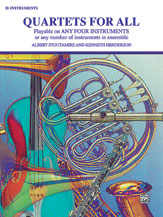
Any combination and any number of instruments can play together in harmony. Woodwinds, brass, strings, and mallet percussion can have fun playing in like-instrument or mixed-instrument ensembles. Quartets for All covers a wide range of styles and music by composers from baroque through contemporary eras. Difficulty ranges from grades I through III. The pages are laid out in an identical manner in each book so that performers can quickly locate a point for discussion or rehearsal. No page turning is required while playing. Quartets for All meets the needs of classmates, friends, family, and neighbors who wish to play together for festivals, concerts or just for fun. Titles: Galiardo (Bull) * Seventh Symphony [Theme] (Beethoven) * Finlandia (Sibelius) * Tarantella (Prokofiev) * Promenade (Gretchaninoff) * The Death of Ase (Grieg) * March of the Men of Harlech (Welsh) * Prelude (Kabalevsky) * March (Gurlitt) * Happy Tune (Stoutamire) * Angeles We Have Heard on High (Carol) * Folk Song (Bartok)
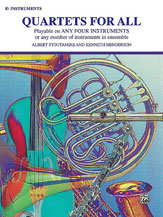
Any combination and any number of instruments can play together in harmony. Woodwinds, brass, strings, and mallet percussion can have fun playing in like-instrument or mixed-instrument ensembles. Quartets for All covers a wide range of styles and music by composers from baroque through contemporary eras. Difficulty ranges from grades I through III. The pages are laid out in an identical manner in each book so that performers can quickly locate a point for discussion or rehearsal. No page turning is required while playing. Quartets for All meets the needs of classmates, friends, family, and neighbors who wish to play together for festivals, concerts or just for fun. Titles: Galiardo (Bull) * Seventh Symphony [Theme] (Beethoven) * Finlandia (Sibelius) * Tarantella (Prokofiev) * Promenade (Gretchaninoff) * The Death of Ase (Grieg) * March of the Men of Harlech (Welsh) * Prelude (Kabalevsky) * March (Gurlitt) * Happy Tune (Stoutamire) * Angeles We Have Heard on High (Carol) * Folk Song (Bartok)