Habits of a Successful Musician: Clarinet

Perfect for use by an entire band or solo player at virtually any skill level, this series contains carefully sequenced warm-ups, sight-reading etudes, rhythm vocabulary builders, and much more. In one place, this series collects everything an aspiring player needs to build fundamental musicianship skills and then be able to transfer those skills directly into the performance of great literature.

Habits of a Successful Musician: Bass Clarinet

Habits of a Successful Musician gives the music teacher a resource that combines pedagogy, technique building, fundamental development, and sight-reading into a single book. I love being able to cover everything without having to juggle multiple method books in the student folders.
—Gary Gribble, Director of Bands, Pope High School, Marietta, GA

Habits of a Successful Musician is a great resource for band directors looking for that warm-up book that offers everything: Breathing and technical exercises, lip slurs, etc. Something is in here for every student in every band in our program, from the most advanced to the most remedial. I found the sight reading section to be particularly helpful, special and unique. Our books were well used at the end of the school year…. What a great teaching tool!!
—Scott Casagrande, Director of Bands, John Hersey High School, Arlington Heights, IL

Habits of a Successful Musician is a vital, field-tested series for building fundamentals and—most importantly—a musical collection of more than 200 sequential sight-reading exercises.

Perfect for use by an entire band or solo player at virtually any skill level, this series contains carefully sequenced warm-ups, sight-reading etudes, rhythm vocabulary builders, and much more. In one place, this series collects everything an aspiring player needs to build fundamental musicianship skills and then be able to transfer those skills directly into the performance of great literature.

Habits of a Successful Musician…

• Provides material for use during fundamentals time that would promote a comprehensive approach to developing skills necessary to fill the musical toolbox.

• Promotes the idea that fundamentals time should transfer directly into the performance of great literature.

• Includes a sequential format that leads to the mastery of reading rhythms and, ultimately, to musical sight-reading.

• Provides chorales for the development of tone quality, ensemble sonority, and musicianship.

• Presents rhythm charts in a new format to allow transfer from timing and rhythm to pitches in a musical context.

• Provides audition etude sight-reading in a full-band format that is well thought-out in scope and sequence.

• Presents exercises in various keys, tonalities, and modes to aid in the development of the complete musician.

• Creates a mindset intent on establishing a culture of excellence for both the full band program and individual players.

Habits of a Successful Musician is the answer to the very simple question: “What should I be learning during fundamentals time?”

Available instrumentation: Flute (G-8127), Oboe (G-8128), Clarinet (G-8129), Bass Clarinet (G-8130), Bassoon (G-8131), Alto Saxophone (G-8132), Tenor Saxophone / TC Baritone (G-8133), Baritone Saxophone (G-8134), Trumpet (G-8135), French Horn (G-8136), Trombone (G-8137), Euphonium (G-8138), Tuba (G-8139), Mallet Percussion (G-8140), and Conductor's edition (G-8125).

A full preview is available online for the Oboe book.

Scott Rush is Director of Bands at Wando High School in Mount Pleasant, South Carolina. Rich Moon teaches elementary music in the Charleston County (SC) School District. Marguerite Wilder is a clincian and education consultant with GIA Publications, Inc., and an instrumental music teacher.

Ultimate Movie Instrumental Solos – Clarinet

Alfred's Ultimate Movie Instrumental Solos series arranged for flute, clarinet, alto sax, tenor sax, trumpet, horn in F, trombone, violin, viola, cello, and optional piano accompaniment. All wind instrument arrangements are fully compatible, and can be successfully performed as ensembles or solos by students who have completed the first book of any standard band method. A fully orchestrated accompaniment MP3 CD is provided, featuring each song as a live performance demo track followed by a play-along track. The CD also contains a PDF of the Piano Accompaniment and Alfred's Tempo Changer Software

Contains 60 songs, including: Cantina Band * Follow the Yellow Brick Road / We're Off to See the Wizard * Gollum's Song * Hedwig's Theme * James Bond Theme * Obliviate * Pink Panther Theme * Raiders March * Superman Theme * Wonka's Welcome Song * and many more.

Due to level considerations regarding keys and instrument ranges, the wind instrument arrangements are not compatible with the string instrument arrangements in this series.

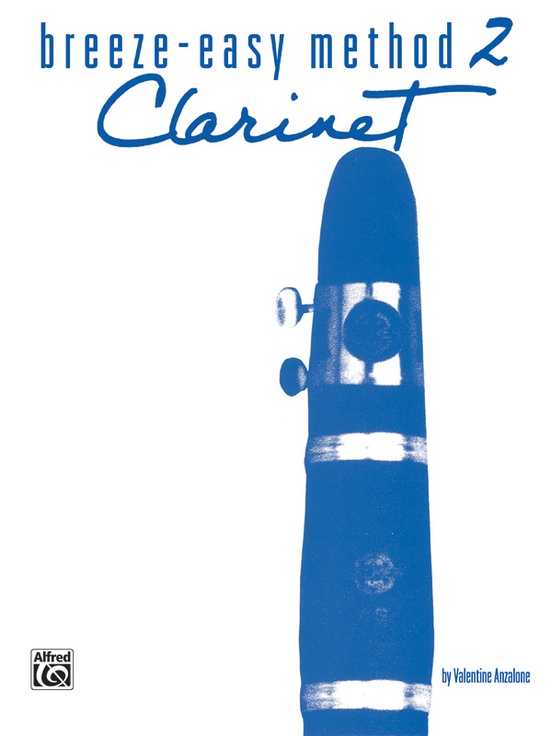
Breeze-Easy Method for Clarinet, Book 2

The Breeze-Easy Series features instrumental methods for individual and group instruction, created by experienced teachers John Kinyon and Valentine Anzalone. It is designed to produce the best musicianship in the greatest number of students in limited teaching situations.

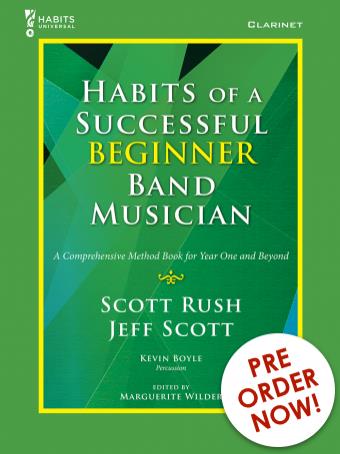
Habits of a Successful Beginner Band Musician – Clarinet

Habits of a Successful Beginner Band Musician is a field-tested, vital, and—most important—musical collection of 225 sequenced exercises for the beginning band student. The book’s cutting-edge online component, Habits Universal, features a backend gradebook that allows students to submit video recordings of their performances as a primary source of assessment. This gradebook is compatible with PowerSchool, Canvas, Google Classroom, Brightspace, Edmodo, Schoology, and many other platforms! In addition, Habits Universal features supplemental rhythm vocabulary sheets, accompaniment tracks, video start-up clinics, as well as a professional video coach for each exercise in the book.

What makes Habits of a Successful Beginner Band Musician unique? Features include:

  • Teacher tips for each exercise in the book.
  • Diatonic solfege that begins on the first day of instruction.
  • Initial exercises on the mouthpiece, mouthpiece and barrel, reed, bocal and reed, or headjoint prior to playing the first notes in the book.
  • Sequential rhythm charts embedded in the book. These same rhythms are then presented with pitches for a seamless transfer to the music students are performing.
  • Technique and skill-building exercises embedded within the method, which helps to prepare students for future Habits exercises.
  • The introduction of the key of Concert C, which results in students playing the pitches B, E, and A more often (as opposed to the typical emphasis on B-flat, E-flat, and A-flat).
  • The introduction of five keys: Concert B-flat, E-flat, A-flat, C, and F. The Concert G scale is also provided in the back of the book.
  • Left (L) and right (R) indicators for woodwinds along with appropriate chromatic alternate fingering indicators.
  • Shaded boxes around first-time challenges in the student books.
    A thorough explanation of (T:1) for trombones and rules for when to use it.
  • Rhythm vocabulary that progresses through quarters, eighths, dotted rhythms, sixteenths, and an eighth and two sixteenths.
  • The sequential introduction of the one-handed breakdown of a percussion rudiment before introducing the rudiment itself.
  • The use of the “enharmonic ladder” and the “call-and-response game” to learn enharmonic notes.
  • A thorough explanation of and markings for the “F dilemma” on oboe.
  • An explanation of appropriate flicking on bassoon.
  • Two pages of slow “clarinets only” work that focuses on going over the break and throat tones.
  • Breeze-Easy Method for Clarinet, Book 1

    The Breeze-Easy Series features instrumental methods for individual and group instruction, created by experienced teachers John Kinyon and Valentine Anzalone. It is designed to produce the best musicianship in the greatest number of students in limited teaching situations.

    Clarinet Concerto “Nekudim”

    The Philadelphia Orchestra continues to commission new works for its principals, and 2016 saw the pairing of Jonathan Leshnoff with Philadelphia principal clarinetist, Ricardo Morales. The Philadelphia Orchestra, under the direction of Yannick Nezet-Seguin, gave the world premiere of the Clarinet Concerto in April 2016. In Leshnoff's writing, the performance depends upon the soloist to “delve deep to unearth the inner meaning of the lines,” while Morales admits, “I'm mesmerized by his melodic style.”

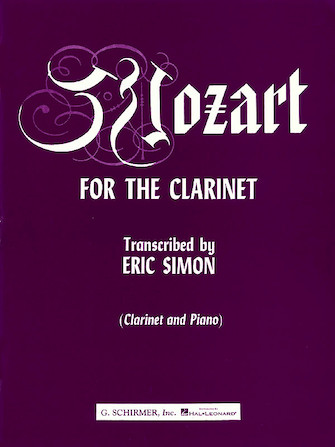
    Mozart for the Clarinet

    Contents: Ein Madchen Oder Weibchen (Papageno's Song) • Minuet In G Major, K. 1/1e • Andante Grazioso, K. 331 (Theme) • Cantradance In B-Flat Major, K. 462, No. 5 • Minuet In D Major, K. 527 • Trio In E-Flat Major, K. 543 • Ach Ich Fuehl's (Pamina's Aria) • Andante, K. 525 • Minuet, K. 334 • Adagio, K. 370 • Rondo In D Major, K. 485 • Voi Che Sapete (Cherubino's Aria) • Pantomime, K. Anh. 10 • Flute Quartet In A Major, K. 298, 2nd Mvt. • Clarinet Concerto, K. 622, 2nd Mvt. • Alleluia, K. 165 • Longing For Spring, K. 596 • Gigue, K. 574

    Carol of the Bells for Clarinet in Bb

    Holiday favorite Carol of the Bells has been arranged for easy clarinet to facilitate performance by any level or age of player. Complete with piano accompaniment, this new solo arrangement is perfect for recital your next holiday gathering.